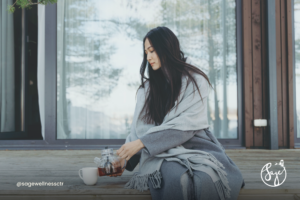
Did you know August 15th is National Relaxation Day?
If your first reaction was a tired laugh, you’re not alone. It almost sounds like a joke — a single day set aside for rest in a culture that treats busyness like a badge of honor. We’re expected to be productive, optimized, and always “in bloom.” There’s never enough time, and somehow the answer is always to move faster.
Maybe this sounds familiar: You finally sit down at the end of the day, and instead of relief, you feel restless. Your mind races through tomorrow’s to-do list. Your shoulders won’t drop. You scroll your phone because true stillness feels almost… uncomfortable. And then you wonder, why is it so hard for me to relax?
Here’s the truth: it’s not a personal failing. Your nervous system has simply learned to live in overdrive — and it can learn something different.
What Is “Rushing Woman Syndrome” (and Why It Describes So Many of Us)
You may have come across the term “Rushing Woman Syndrome,” coined by biochemist Dr. Libby Weaver to describe living in a near-constant state of urgency — juggling work, caregiving, households, and invisible mental loads while stress hormones stay switched on around the clock.
The name came from Dr. Weaver’s observations of her patients, but the pattern itself doesn’t belong to any one gender. Anyone carrying the invisible labor of holding a family, a workplace, or a community together can find themselves stuck in this cycle — women, men, nonbinary and gender-expansive folks, parents, caregivers, teens. Really, it’s a description of our culture: we’ve normalized a pace that no human body was designed to sustain.
If you’ve ever asked yourself, “Why am I so stressed all the time, even when nothing is technically wrong?” — this is often why. Chronic rushing keeps the body’s stress response (the sympathetic “fight-or-flight” system) activated long after the actual demands have passed.
Why You Can’t Just “Decide” to Relax: A Nervous System Perspective
Relaxation isn’t a mindset — it’s a physiological state. When your nervous system has spent months or years in high alert, stillness can actually feel unsafe at first. Your body has adapted to urgency, so slowing down registers as unfamiliar, even threatening.
Over time, chronic stress can show up as:
- Trouble sleeping, even when you’re exhausted
- Irritability or feeling emotionally “on edge”
- Tension headaches, jaw clenching, or tight shoulders
- Difficulty being present with the people you love
- A sense of disconnection — from your body, your joy, or yourself
The good news? Nervous systems are remarkably adaptable. Just as your body learned to rush, it can relearn how to rest. That relearning starts not with doing more, but with becoming aware of what’s happening inside you — and gently, consistently offering your body evidence that it’s safe to slow down.
How to Stop Feeling Rushed: 5 Practices to Step Off the Merry-Go-Round
You don’t need a week-long retreat to begin. Small, repeated moments of regulation are what actually rewire the nervous system. Here’s where to start:
1. Try the physiological sigh (60 seconds).
Take a deep breath in through your nose, then a second short “sip” of air on top of it, and release with a long, slow exhale through your mouth. Repeat 3–5 times.
This extended exhale activates the parasympathetic nervous system — your body’s built-in brake pedal — and is one of the fastest research-supported ways to calm your body in real time.
2. Practice “transition pauses.”
Before you walk in the front door, start your car, or open your laptop, pause for three breaths.
These micro-moments of stillness interrupt the momentum of rushing and remind your body it doesn’t have to sprint through every hour.
3. Name it to tame it.
When you notice urgency rising, silently name what you feel: “I’m feeling rushed right now.”
Simple awareness shifts activity from the reactive parts of the brain toward the reflective ones — and creates just enough space to choose your next step instead of being carried by it.
4. Schedule white space like it’s an appointment.
Not another task — actual unscheduled time. Even 20 minutes. Protect it the way you’d protect a doctor’s visit, because in a very real sense, it is one.
5. Reframe rest as productive.
Rest isn’t the absence of progress; it’s what makes sustainable growth possible. A field left fallow isn’t failing — it’s restoring. You’re allowed to have seasons that aren’t about blooming.
Whole-Person Healing: Mind, Body, and Spirit
Chronic rushing doesn’t just live in your calendar — it lives in your thoughts, your muscles, and even your sense of meaning. That’s why lasting change usually involves the whole person:
- Mind: Therapy can help you understand why stillness feels unsafe — often there are old patterns, perfectionism, or past experiences underneath the rushing.
- Body: Practices like breathwork, gentle movement, yoga, and Reiki help release stored tension and teach the body what safety feels like.
- Spirit: Reconnecting with what genuinely matters to you — purpose, community, faith, nature — gives you a reason to slow down that’s stronger than the pressure to speed up.
When these pieces work together, relaxation stops being something you chase one day a year and becomes a way of coming home to yourself.
You Don’t Have to Figure This Out Alone
If you’ve been asking “what can I do to relax?” for a while now and nothing seems to stick, that’s often a sign that your nervous system needs more than tips — it needs guided, compassionate support. Working with a therapist or holistic practitioner can help you understand your unique stress patterns and build a path back to calm that actually fits your life.
For those of us here in Orange County, where the pace of life can feel especially relentless, local support matters. At S.A.G.E. Holistic Health & Wellness Center in Santa Ana, our team integrates evidence-based therapy with holistic practices like mindfulness, breathwork, and Reiki — because healing happens in the mind, body, and spirit together. We offer free 15-minute consultations if you’d like to explore whether we’re a good fit.
This National Relaxation Day, maybe the invitation isn’t to relax perfectly for 24 hours. Maybe it’s simpler than that: pause, take one long exhale, and remember — you were never meant to live your whole life in a rush.