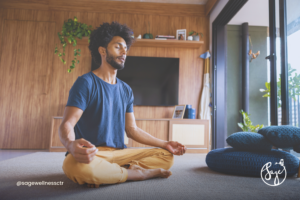
Have you ever noticed that even when your mind says, “Everything is fine,” your body still feels tight, restless, or on edge?
Maybe you’re:
- Snapping more easily than you’d like
- Feeling exhausted but wired at night
- Struggling to slow down, even when you finally have a moment to yourself
- Going through the motions but feeling disconnected from your own life
For many adults (especially parents juggling work, caregiving, and everything in between), stress doesn’t just live in our thoughts—it settles into our nervous system. And while talk therapy can be incredibly supportive, sometimes what we really need is a way to reconnect with our body.
This is where a trauma-informed yoga practice can become a powerful part of holistic healing—both on and off the mat.
What Is Yoga, Really?
Yoga is an ancient practice that originated in India and supports holistic wellbeing through movement, breath, and awareness.
The word yoga comes from the Sanskrit root “yuj,” meaning to yoke, unite, or join. In other words:
“Yoga is about integrating the mind, body, and inner awareness.“
In a trauma-informed yoga practice, the goal isn’t to push your body into a perfect pose. It’s to gently:
- Notice what’s happening inside
- Build awareness of physical sensations
- Learn how to respond to stress in a more regulated way
Whether you’re exploring yoga near you in Orange County or simply becoming more curious about the mind and body connection, this practice can offer tools for sustainable wellbeing that extend far beyond physical exercise.
The Benefits of Yoga for Mental Health and Nervous System Regulation
When offered in an accessible and supportive way, yoga can help:
- Improve nervous system regulation and stress response
- Increase body awareness and mind-body connection
- Enhance emotional regulation and self-attunement
- Support mobility, strength, and flexibility over time
- Cultivate a greater sense of grounding and presence
- Foster connection to self, others, and community through shared practice
Yoga helps create moments of stillness—tiny pauses where your nervous system can shift out of survival mode and into a place of rest, safety, and repair.
Over time, this supports your ability to:
- Stay present during difficult conversations
- Notice overwhelm before it becomes burnout
- Move through emotions instead of shutting down or spiraling
Common Misconceptions About Yoga
❌ “Yoga Is a Religion”
Yoga is not a religion—though it can feel spiritual for some people.
Practicing yoga does not mean you are praying to Lord Shiva or Ganesh. Practices like stillness, breath awareness, or gentle movement may naturally guide you to wonder about life in deeper ways—but they don’t have to.
You get to decide what meaning (if any) you bring to the experience.
❌ “Yoga Is Only About Flexibility or Poses”
Yoga isn’t about achieving perfect poses or becoming more flexible.
It’s about learning how to be with yourself—just as you are.
Yoga is truly for:
- Every body
- Every stage of life
- Every starting point
❌ “You Need to Be Calm or Fit to Do Yoga”
Yoga is not something you earn by becoming calm first.
It’s a practice for meeting yourself where you are—whether that’s anxious, overwhelmed, distracted, or emotionally drained.
You don’t need prior experience, flexibility, or a quiet mind to begin.
❌ “Yoga Is Only Physical Exercise”
Movement is one part of yoga—but so are:
- Breath
- Attention
- Awareness
- Mindfulness
Yoga teaches tools for self-regulation that can help you navigate stress at work, during parenting challenges, or even in moments of conflict—far beyond what happens on the mat.
A Whole-Person Approach to Healing
At S.A.G.E. Holistic Health & Wellness Center here in Orange County, we often talk about healing as something that happens across the mind, body, and spirit.
Sometimes insight alone isn’t enough.
Sometimes your nervous system needs a felt sense of safety before your thoughts can shift.
Practices like trauma-informed yoga can:
- Support the mind through increased awareness
- Support the body through movement and breath
- Support your inner world through stillness and self-connection
Working with a therapist or holistic practitioner can help you integrate these experiences—so they don’t just feel good in class, but become part of how you move through daily life.
4 Simple Yoga-Inspired Tools for Nervous System Support
You don’t need an hour-long class to begin experiencing the benefits of yoga.
Try one of these:
1. 3-Minute Grounding Breath
Place one hand on your chest and one on your belly.
Inhale slowly through your nose for 4 seconds.
Exhale gently through your mouth for 6 seconds.
Repeat for 3 minutes to signal safety to your nervous system.
2. Notice Your Feet
Pause wherever you are and feel your feet on the floor.
Ask yourself:
“Can I feel the ground supporting me right now?“
This simple awareness cue can bring you back into the present moment.
3. Gentle Shoulder Rolls
Roll your shoulders slowly back and down for 30 seconds.
Notice:
- Temperature
- Tension
- Ease
Awareness itself can create subtle shifts in regulation.
4. One Minute of Stillness
Set a timer for 60 seconds.
Sit or lie down without distraction and simply notice:
- Your breath
- Your posture
- Your surroundings
You don’t need to change anything—just observe.
Finding Support in Community
Many people discover that practicing yoga in a supportive community helps normalize their experience and creates space for acceptance and growth.
Whether you’re searching for:
- Yoga for stress relief
- Trauma-informed yoga practice
- Holistic wellness support in Orange County
You don’t have to navigate it alone.
Moving Toward Sustainable Wellbeing
Yoga offers an invitation—not to become someone new—but to reconnect with the parts of yourself that may have gotten lost in the busyness of everyday life.
With consistent practice, you may find:
- More clarity
- Greater resilience
- A deeper sense of connection to yourself and others
If you’re feeling overwhelmed, disconnected, or stuck, working with a therapist or engaging in holistic practices like yoga can be a meaningful step toward sustainable wellbeing.
Take a breath.
Notice where you are.
And remember—you’re allowed to begin exactly as you are. 💜
Discover your next healing experience: https://sagewellnessctr.org/events-calendar/